• The Complete Annmarie
Gianni Skin Care Line

Ingredient Showcase: Tamanu Oil, the Ancient Skin-Regenerator and Healer

Wednesday, August 29th, 2012

Tamanu oil is  an ancient remedy that comes from the Tamanu tree, which grows in tropical Southeast Asia. The oil itself comes from the kernels found inside the nut that’s inside the fruit. The kernels are dried for two months until they become sticky with a dark, thick, rich oil. The oil is then cold-pressed to make a greenish yellow oil similar to olive oil.

Traditional island natives used tamanu oil to soothe and treat everything from skin ulcers, boils, and cuts to rashes, open sores and sunburn. In fact, this precious oil has a long and impressive history as a miracle product for the skin.

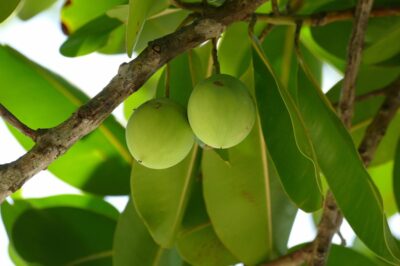
This rugged-looking tree produces a fragrant oil that helps soothe all sorts of skin conditions.

A Little Bit About the Ingredient Itself

Also called the kamani tree, the ati tree, and foraha, tamanu is scientifically termed Calophyllum inophyllum, and is considered a large evergreen. It usually grows to about 26 to 66 feet in height, and is found in Thailand, Vietnam, Myanmar, Malaysia, South India, Sri Lanka, and the Melanesian and Polynesian islands. Leaves are elliptical and shiny, and the bark is cracked and black. Large, white flowers bloom twice a year, and yield clusters of yellow-skinned spherical fruit that are reported to taste similar to apples.

Inside the fruit is a large nut, which contains an odorless pale kernel. It is this kernel that yields the oil once dried. The oil is precious, as it takes about 100 kilograms of fruit—the amount that one tree produces annually—to create just 5 kilograms (about 21 cups) of cold pressed oil.

Traditional Uses

Traditionally, tamanu oil was used to help treat all sorts of skin conditions. Fiji natives used it for bruises, oozing wounds, chapped lips and for preventing diaper rash, as well as to help treat joint pain and arthritis. Pacific islanders used it to soothe scrapes, cuts, burns, insect bites and stings, acne and acne scars, psoriasis, diabetic sores, sunburn, blisters, eczema, and dry and scaly skin.

Since the oil has a light, mild and pleasant aroma—compared to butter pecan ice cream—natives also used it to reduce body odor.

Current Skin Benefits

Research for over a century has found that tamanu can be especially beneficial for difficult skin conditions. French scientists found, for example, that wounds caused by gangrene ulcers, boiling water burns, and chemical burns were successfully treated with tamanu oil when other treatments weren’t working.

Tamanu is also a powerful anti-inflammatory, which is why it’s effective in treating eczema and psoriasis, as well as cuts and wounds. The oil’s antimicrobial action also helps keep wounds free of germs and bacteria while they heal. These two properties together have given tamanu a reputation for helping to heal athlete’s foot, ringworm, jock itch, hemorrhoids, ulcers, bedsores, infected nails, and pimples.

What we find particularly exciting today about tamanu is that it has a unique ability to promote the formation of new tissue. It is this ability that seems to make it especially effective in wound healing—but it also makes it a great addition to anti-aging formulas, as it helps promote the growth of healthy, younger-looking skin. The oil penetrates deep into the connective tissues to promote new growth. Combined with its antioxidant properties, it works not only to promote the growth of new tissue, but to protect that new tissue from environmental assaults.

BioScience Laboratories conducted a study on tamanu oil’s ability to improve the appearance of scars, and found that after application twice daily for nine weeks, there was significant improvement, with scar length and width reduced.

Finally, like many natural oils, tamanu is a good source of fatty acids, including oleic, palmitic, linoleic, linolenic, and stearic, which all help to plump and smooth the appearance of skin.

Try It!

I’ve added tamanu to a couple of my anti-aging formulas as well as my standard facial oils. Use these daily and you’re likely to see the regenerating and scar-fading properties of tamanu oil at work!

Have you tried tamanu for difficult skin conditions? Please share your story.

* * *

Photo courtesy snapboot via Flickr.com.

Source
Dweck, A.C.: Calophyllum inophyllum – Tamanu oil the African, Asian, Polynesian and Pacific Panacea. International Journal of Cosmetic Science 24, 6, 1-8 (2002).

Tags: , , , , , , , , , , , , , , , , , , , , , ,

Leave a Reply